Norwich Cycling Campaign logo

Norwich Cycling Campaign Newsletter
May 2020

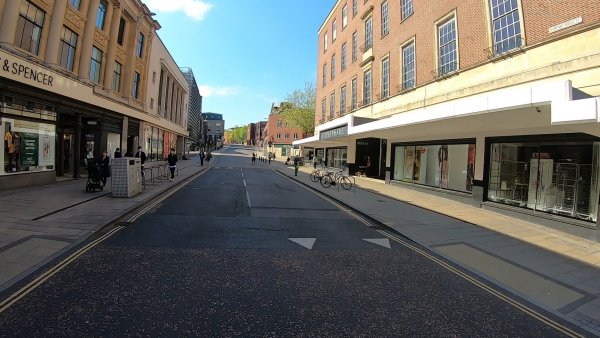
Rampant Horse Street during the lockdown (picture Derek)

The past couple of months has been very difficult for a lot of people, but it’s also provided an opportunity to explore the city wonderfully devoid of cars, full of birdsong and with weather that has been ideal for most of the time. I hope some of you made it out on your bikes and were able to experience this unique period which managed to be both eerie and beautiful at the same time.

If all goes well we might be seeing the start of the crawl out of the lockdown now and with luck life can get back to some sort of normal, but it won’t be a quick return to business as usual, I think we all know that.

One aspect of this is that cities will have to change, not least of all in terms of how we get around. Because of the need to keep socially distancing the buses can only take a tiny proportion of the people who need to travel and for the same reason pedestrians will need more pavement space.

Rather unhelpfully the government has advised people to travel by car if possible instead of using the bus, but it also accepts that if even a small proportion of people who commute by bus switch to cars there will be hopeless grid lock. So at last the government has realised the value of encouraging people to travel by bike and it looks like it's really going to happen.

 BBC News reported

How coronavirus is driving a revolution in travel

“The government has acknowledged that resolving how we can travel while maintaining social distancing is one of the biggest challenges it faces as it starts to lift the lockdown.  The current message is: don't use public transport if you can avoid it, yet if people take to their cars, our streets will be choked with traffic. Last week, the government announced what it called a "once in a generation" investment to change the way Britain gets around.

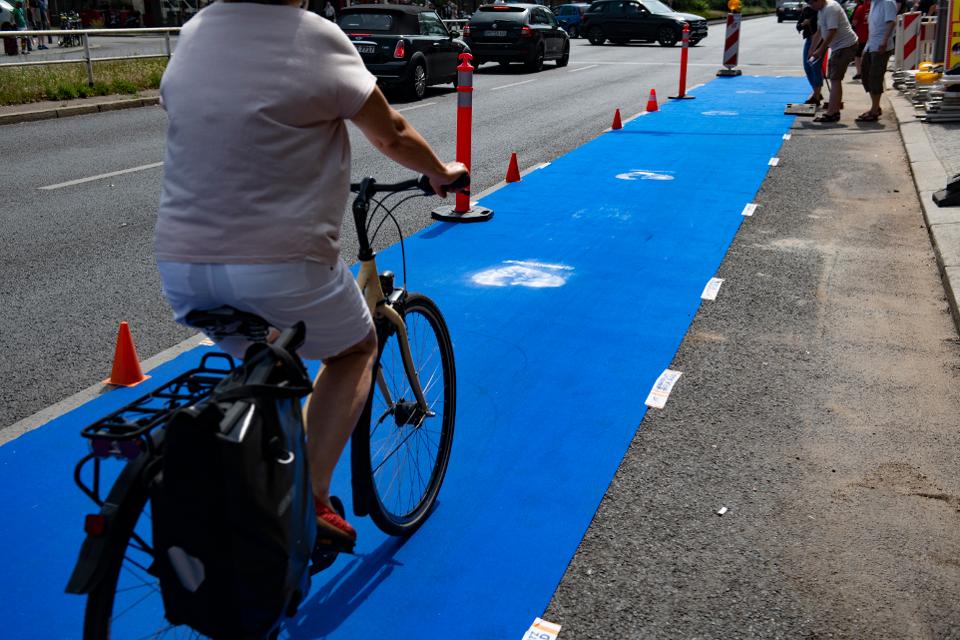
NZ pop up cycle lane

A pop up cycle lane in New Zealand, the first country to do this (picture Forbes)

Reallocating road space for pedestrians and cyclists

The government has recognised this problem and has decided to spend money creating a temporary cycle network to encourage commuting and general travel by bike. This could be a chance to show how a properly designed cycle network would benefit the city and hopefully to generate so much extra cycle traffic it will have to be come permanent.

Before we get too excited though it's worth bearing in mind this isn't new money being found for cycle infrastructure, it's actually the money allocated in the recent budget for cycling. However, this would seem to be a chance to bring about a very real change for the better.

The campaign has contacted Norfolk County Council to see what plans they have in place and frankly it seems this has taken them pretty much by surprise, planning is in the very early stages right now. The campaign has asked to be involved in this process and we have had an encouraging response.


Back to basics

What seems to be on offer is a set of routes that offer safe, protected cycle lanes designed for serious use.

That means they have to allow for reasonable cycling speeds, we’re suggesting a design speed of 30 Km/H (20 mph) with, of course, room to overtake and with priority at side roads. We have asked for a lane width of 2M for a single direction lane, 4m for two way. This will mean closing 8M of road space to motor vehicles, plus any extra space needed for widened pavements.

Of course the routes have to connect up, a super fast cycle lane that stops dead at a busy roundabout is of no use.

We are strongly opposed to shared use pavements in any case, but they are totally unacceptable for this sort of plan. If we are to encourage serious commuting and travel by bike, increasing the number of cyclists and their speed, there can be no room for pedestrians on the cycle lane. This unfortunately means that the vast majority of the pedalway infrastructure is simply not fit for purpose as we have been saying since it was constructed.

That said, there are some significant sections which might be capable of upgrade given some fairly minor works, the routes around Bluebell Road and Earlham Green Lane for example, if they were made cycle only with priority at junctions.

A deserted Pink Pedalway during the lockdown (picture Derek)

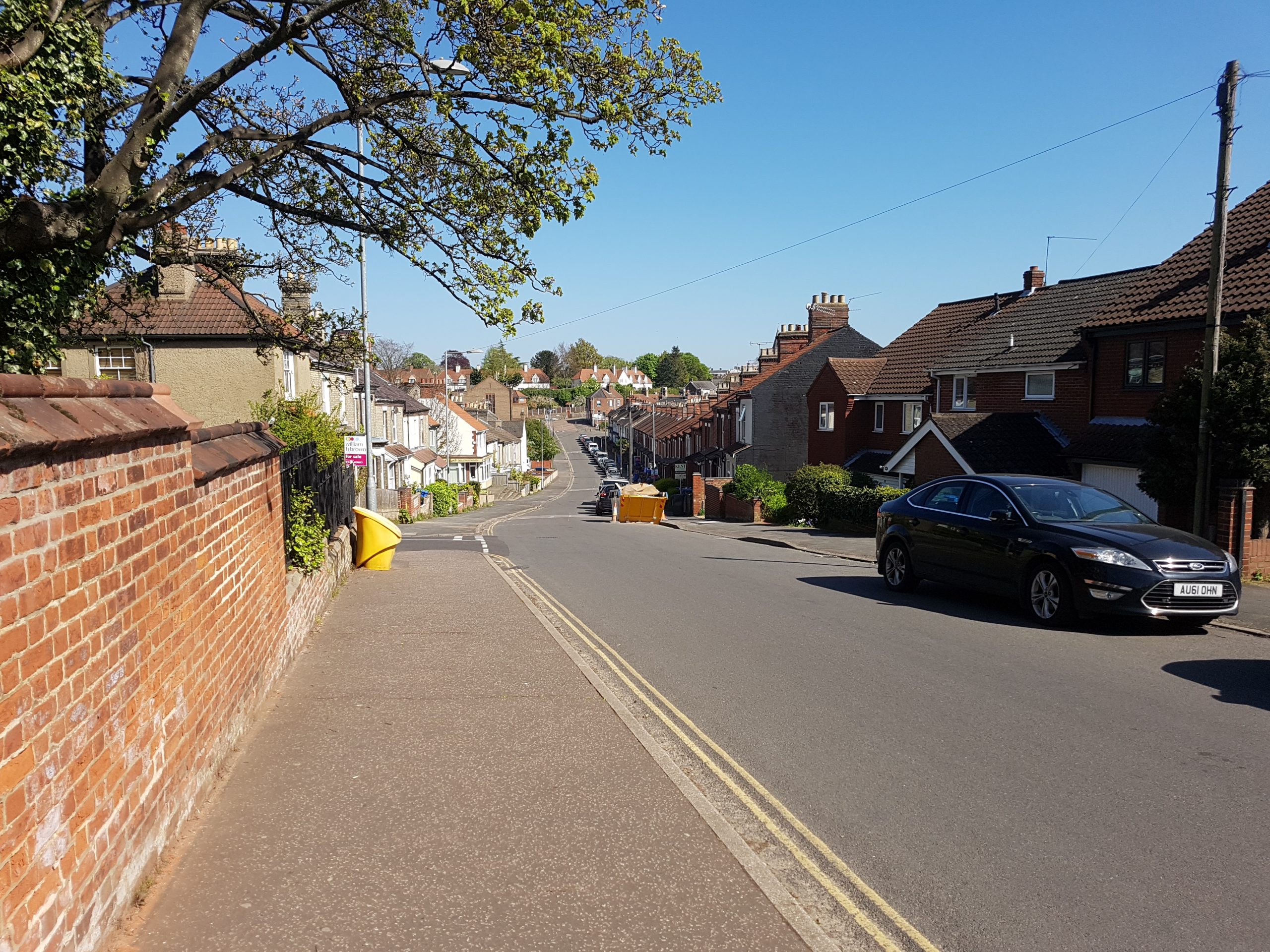
Avenue Road on the Pink Pedalway during lockdown (Picture Derek)

Also in this area the Pink pedalway running along The Avenues offers a more direct route from the city to the UEA,  hospital etc than Earlham Road and with less traffic issues, we are therefore suggesting that this becomes the signed route for cycling.

The section of Park Lane from Unthank Road to Avenue Road however has very narrow pavements and large amounts of traffic and will therefore need to be closed to traffic. This was a hot topic when the route was planned and the motorist lobby campaigned hard for it to remain open, but things have now changed and the case for closing is now much stronger. Closing Park Lane would greatly cut the amount of traffic using the Avenues and so make the route better for cyclists. Other measures would be needed closer to UEA to significantly reduce the traffic using the Avenues, especially once UEA opens up again.

In the city Duke Street has been working as single lane for some years now and we’re arguing this might as well continue, allowing wider pavements and a contraflow cycle lane toward the city.

The other big issue is on-street parking which makes pavement widening impossible and creates obstacles for cycle routes. We are saying that where possible on-street parking should be banned on  feeder routes and things like parking bays, which would require vehicles to cross the cycle lane, should be closed.

Further afield a reasonable cycle commute for a fit person on a good bike would be up to 10 miles, so cycle commuting into Norwich from the nearby towns is entirely possible. From the Wymondham direction there is a cycle path which is almost good but suffers the same issues as all the others, principally shared use with substandard junction designs. Again if this is to be a serious cycling option it will need a bit of upgrading.

From towns to the north and east though there is presently nothing in place for cyclists. Cycling requires direct routes, which really means being able to use the main roads. There is also the problem of the substandard cycle crossing of the NDR which will need sorting out.

It may be that we have to look at a slightly longer route if it can be made traffic free.

Ideas please

This is potentially the biggest and best opportunity we have ever had to reclaim the roads for cycle use. There are obviously huge issues to overcome and there will be difficult choices to make.. Tthe more input the campaign gets from around the city the more involved we can be.

This is really important; We would very much like to hear from you about the routes you are familiar with in your area and ideas you have. Do you cycle commute already? What would help make your journey better, easier and faster?

This is likely to be a fast developing situation over the next month or so as lockdown eases.  So please send us your thoughts and suggestions, now is definitely the time!

An empty Timberhill

A deserted Timber Hill during lockdown (picture Derek)

Electric bikes, scooters and other emerging ways of getting about 

Another issue to throw in to all this is the growing use of electric bikes, scooters and such, new transport forms that can be expected to become more popular as a result of all this. Bikes will be sharing the new cycle lanes with a wide range of personal transport forms. This is all good and will help the long term movement away form car based transport.  Electric bikes especially will enable far more people to commute without a car, but do pose the problem of higher speeds in the cycle lane which is why the design spec of the new lanes needs to be properly established.

Electric bikes 'could help people return to work' (BBC)

Some useful background reading

Statutory guidance: Reallocating road space in response to COVID-19: statutory guidance for local authorities (UK gov)

Designing for cycle traffic e-learning – An online teaching aid for cycle project design from Highways England

And Finally

Prince of wales road cycle path

Click the image for a video of the Prince of wales Road cycle track in all its glory - video Derek

The Prince of wales Road cycle track is just about complete

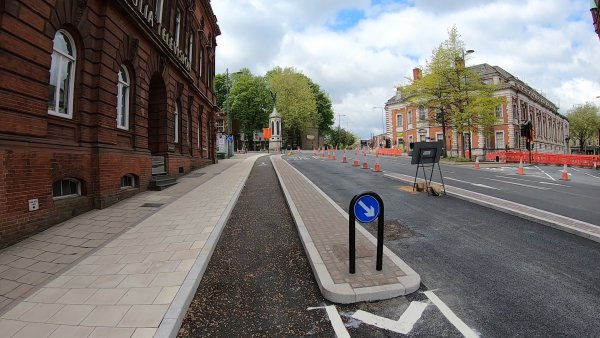
It seems a lifetime ago (it was less than six months) but remember the whole debacle over the Prince of wales cycle track? The whole project was just about finished before the lock-down with the extension to Castle Meadow featuring a short section of segregated cycle route. This short section of segregation came about following our complaints about the main part of the route. I took a ride along it one day during my lockdown exercise period.

This video shows why this badly designed path is unfit for use as a serious cycle route, but we can be proud of the little bit at the top of the road.